Determine if a map between Euclidean vector spaces is linear or not.
Subsection20.1.1Warm Up
Activity20.1.
(a)
What is our definition for a set \(S\) of vectors to be linearly independent?
(b)
What specific calculation would you perform to test is a set \(S\) of Euclidean vectors is linearly independent?
Activity20.2.
(a)
What is our definition for a set \(S\) of vectors in \(\IR^n\) to span \(\IR^n\) ?
(b)
What specific calculation would you perform to test is a set \(S\) of Euclidean vectors spans all of \(\IR^n\) ?
Subsection20.1.2Class Activities
Definition20.3.
A linear transformation (also called a linear map) is a map between vector spaces that preserves the vector space operations. More precisely, if \(V\) and \(W\) are vector spaces, a map \(T:V\rightarrow W\) is called a linear transformation if
\(T(\vec{v}+\vec{w}) = T(\vec{v})+T(\vec{w})\) for any \(\vec{v},\vec{w} \in V\text{,}\) and
\(T(c\vec{v}) = cT(\vec{v})\) for any \(c \in \IR,\) and \(\vec{v} \in V\text{.}\)
In other words, a map is linear when vector space operations can be applied before or after the transformation without affecting the result.
Definition20.4.
Given a linear transformation \(T:V\to W\text{,}\)\(V\) is called the domain of \(T\) and \(W\) is called the co-domain of \(T\text{.}\)
Figure264.A linear transformation with a domain of \(\IR^3\) and a co-domain of \(\IR^2\)
Observation20.5.
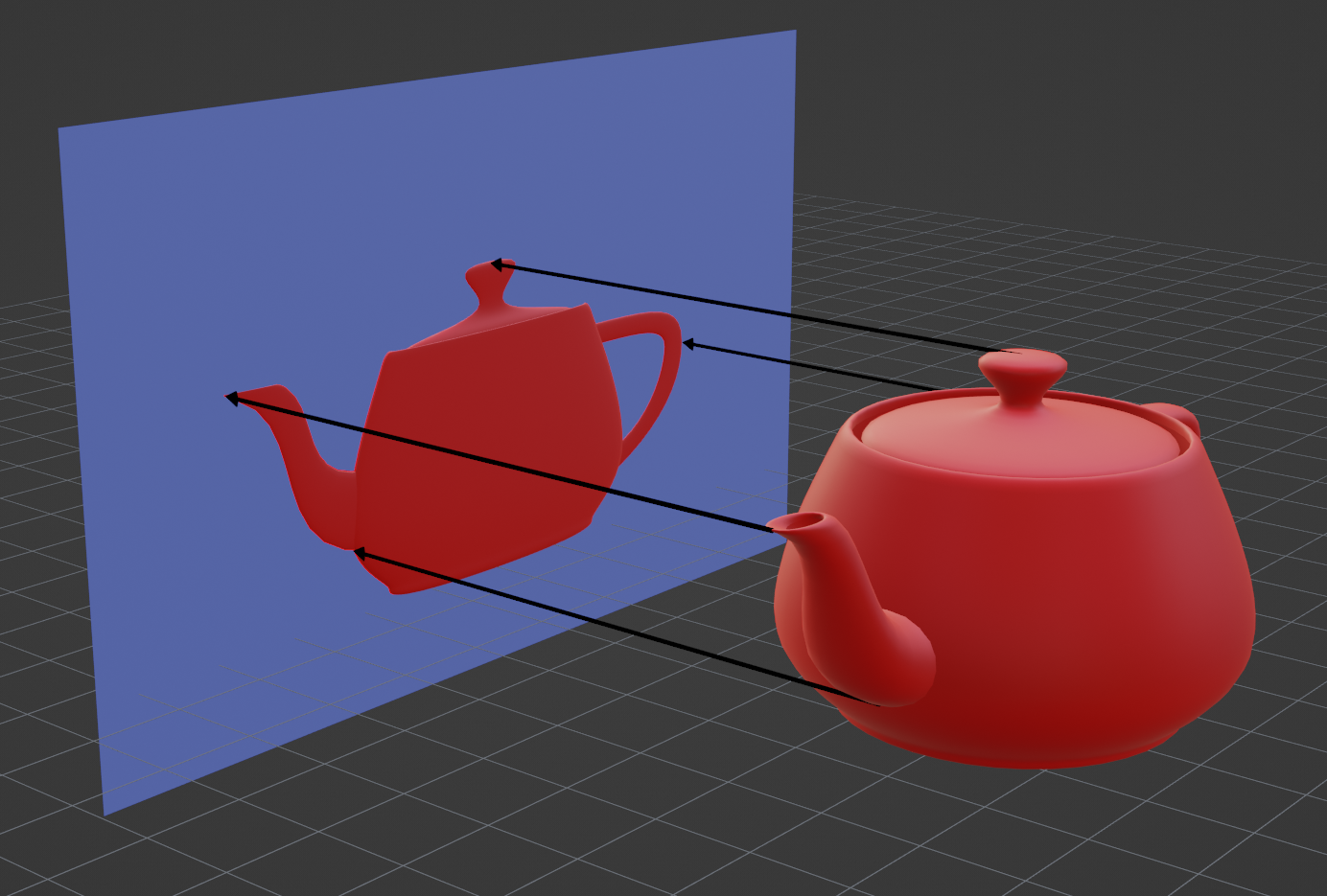
One example of a linear transformation \(\IR^3\to\IR^2\) is the projection of three-dimensional data onto a two-dimensional screen, as is necessary for computer animation in film or video games.
Figure265.A projection of a \(3D\) teapot onto a \(2D\) screen
Activity20.6.
Let \(T : \IR^3 \rightarrow \IR^2\) be given by
\begin{equation*}
T\left(\left[\begin{array}{c} x \\ y \\ z \end{array}\right] \right)
=
\left[\begin{array}{c} x-z \\ 3y \end{array}\right].
\end{equation*}
(a)
Compute the result of adding vectors before a \(T\) transformation:
\begin{equation*}
T\left(
\left[\begin{array}{c} x \\ y \\ z \end{array}\right] +
\left[\begin{array}{c} u \\ v \\ w \end{array}\right]
\right)
=
T\left(
\left[\begin{array}{c} x+u \\ y+v \\ z+w \end{array}\right]
\right)
\end{equation*}
In summary, any one of the following is enough to prove that \(T:V\to W\) is not a linear transformation:
Find specific values for \(\vec v,\vec w\in V\) such that \(T(\vec v+\vec w)\not=T(\vec v)+T(\vec w)\text{.}\)
Find specific values for \(\vec v\in V\) and \(c\in \IR\) such that \(T(c\vec v)\not=cT(\vec v)\text{.}\)
Show \(T(\vec 0)\not=\vec 0\text{.}\)
If you cannot do any of these, then \(T\) can be proven to be a linear transformation by doing both of the following:
For all \(\vec v,\vec w\in V\) (not just specific values), \(T(\vec v+\vec w)=T(\vec v)+T(\vec w)\text{.}\)
For all \(\vec v\in V\) and \(c\in \IR\) (not just specific values), \(T(c\vec v)=cT(\vec v)\text{.}\)
(Note the similarities between this process and showing that a subset of a vector space is or is not a subspace: Remark 19.42.)
Activity20.10.
(a)
Consider the following maps of Euclidean vectors \(P:\mathbb R^3\rightarrow\mathbb R^3\) and \(Q:\mathbb R^3\rightarrow\mathbb R^3\) defined by
\begin{equation*}
P\left( \left[\begin{array}{c} x \\ y \\ z \end{array}\right] \right)=
\left[\begin{array}{c} -2 \, x - 3 \, y - 3 \, z \\ 3 \, x + 4 \, y + 4 \, z \\ 3 \, x + 4 \, y + 5 \, z \end{array}\right]
\hspace{1em} \text{and} \hspace{1em} Q\left( \left[\begin{array}{c} x \\ y \\ z \end{array}\right] \right)=
\left[\begin{array}{c} x - 4 \, y + 9 \, z \\ y - 2 \, z \\ 8 \, y^{2} - 3 \, x z \end{array}\right].
\end{equation*}
Which do you suspect?
\(P\) is linear, but \(Q\) is not.
\(Q\) is linear, but \(P\) is not.
Both maps are linear.
Neither map is linear.
(b)
Consider the following map of Euclidean vectors \(S:\mathbb R^2\rightarrow\mathbb R^2\)
\begin{equation*}
S\left( \left[\begin{array}{c} x \\ y \end{array}\right]\right)= \left[\begin{array}{c} x + 2 \, y \\ 9 \, x y \end{array}\right].
\end{equation*}
Prove that \(S\)is not a linear transformation.
(c)
Consider the following map of Euclidean vectors \(T:\mathbb R^2\rightarrow\mathbb R^2\)
\begin{equation*}
T\left( \left[\begin{array}{c} x \\ y \end{array}\right] \right)= \left[\begin{array}{c} 8 \, x - 6 \, y \\ 6 \, x - 4 \, y \end{array}\right].
\end{equation*}
Prove that \(T\)is a linear transformation.
Subsection20.1.3Individual Practice
Activity20.11.
Let \(f(x)=x^3-1\text{.}\) Then, \(f\colon\IR\to\IR\) is a function with domain and codomain equal to \(\IR\text{.}\) Is \(f(x)\) is a linear transformation?
Activity20.12.
Consider two vectors \(\vec{u},\vec{v}\) and their sum \(\vec{u}+\vec{v}\text{.}\)
(a)
Is it the case that rotating \(\vec{u}+\vec{v}\) about the origin by \(\frac{\pi}{2}=90^\circ\) is the same as first rotating each of \(\vec{u},\vec{v}\) and then adding them together?
(b)
Is it the case that rotating \(5\vec{u}\) about the origin by \(\frac{\pi}{2}=90^\circ\) is the same as first rotating \(\vec{u}\) by \(\frac{\pi}{2}=90^\circ\) and then scaling by \(5\text{?}\)
(c)
Based on this, do you suspect that the transformation \(R\colon\IR^2\to\IR^2\) given by rotating vectors about the origin through an angle of \(\frac{\pi}{2}=90^\circ\) is linear? Do you think there is anything special about the angle \(\frac{\pi}{2}=90^\circ\text{?}\)
Activity20.13.
In Activity 19.16, we made an analogy between vectors and linear combinations with ingredients and recipes. Let us think of cooking as a transformation of ingredients. In this analogy, would it be appropriate for us to consider "cooking" to be a linear transformation or not? Describe your reasoning.
Subsection20.1.4Videos
Figure266.Video: Showing a transformation is linearFigure267.Video: Showing a transformation is not linear
If \(V,W\) are vectors spaces, with associated zero vectors \(\vec{0}_V\) and \(\vec{0}_W\text{,}\) and \(T:V \rightarrow W\) is a linear transformation, does \(T(\vec{0}_V) = \vec{0}_W\text{?}\) Prove this is true, or find a counterexample.
Exploration20.15.
Assume \(f: V \rightarrow W\) is a linear transformation between vector spaces. Let \(\vec{v} \in V\) with additive inverse \(\vec{v}^{-1}\text{.}\) Prove that \(f(\vec{v}^{-1}) = [f(\vec{v})]^{-1}\text{.}\)