Approximate definite integrals using Riemann sums.
Subsection12.2.1Activities
Activity12.10.
Suppose that a person is taking a walk along a long straight path and walks at a constant rate of 3 miles per hour.
(a)
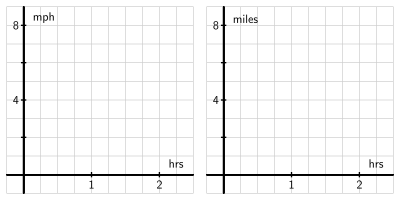
On the left-hand axes provided in Figure 136, sketch a labeled graph of the velocity function \(v(t) = 3\text{.}\)
Figure136.At left, axes for plotting \(y = v(t)\text{;}\) at right, for plotting \(y = s(t)\text{.}\)
Note that while the scale on the two sets of axes is the same, the units on the right-hand axes differ from those on the left. The right-hand axes will be used in question (d).
(b)
How far did the person travel during the two hours? How is this distance related to the area of a certain region under the graph of \(y = v(t)\text{?}\)
(c)
Find an algebraic formula, \(s(t)\text{,}\) for the position of the person at time \(t\text{,}\) assuming that \(s(0) = 0\text{.}\) Explain your thinking.
(d)
On the right-hand axes provided in Figure 136, sketch a labeled graph of the position function \(y = s(t)\text{.}\)
(e)
For what values of \(t\) is the position function \(s\) increasing? Explain why this is the case using relevant information about the velocity function \(v\text{.}\)
Activity12.11.
Suppose that a person is walking in such a way that her velocity varies slightly according to the information given in Table 137 and graph given in Figure 138.
\(t\)
\(v(t)\)
\(0.00\)
\(1.500\)
\(0.25\)
\(1.789\)
\(0.50\)
\(1.938\)
\(0.75\)
\(1.992\)
\(1.00\)
\(2.000\)
\(1.25\)
\(2.008\)
\(1.50\)
\(2.063\)
\(1.75\)
\(2.211\)
\(2.00\)
\(2.500\)
Table137.Velocity data for the person walking.
Figure138.The graph of \(y = v(t)\text{.}\)
(a)
Using the grid, graph, and given data appropriately, estimate the distance traveled by the walker during the two hour interval from \(t = 0\) to \(t = 2\text{.}\) You should use time intervals of width \(\Delta t = 0.5\text{,}\) choosing a way to use the function consistently to determine the height of each rectangle in order to approximate distance traveled.
(b)
How could you get a better approximation of the distance traveled on \([0,2]\text{?}\) Explain, and then find this new estimate.
(c)
Now suppose that you know that \(v\) is given by \(v(t) = 0.5t^3-1.5t^2+1.5t+1.5\text{.}\) Remember that \(v\) is the derivative of the walker’s position function, \(s\text{.}\) Find a formula for \(s\) so that \(s' = v\text{.}\)
(d)
Based on your work in (c), what is the value of \(s(2) - s(0)\text{?}\) What is the meaning of this quantity?
Definition12.12.
If \(f(x)\) is a function defined on the interval \([a,b]\text{,}\) a Riemann sum for \(f\) on \([a,b]\) is a sum of the form
where \(a = x_0 \lt x_1 \lt \dots \lt x_{n-1} \lt x_n = b\) and where \(s_{i}\) is a point in the \(i\)-th subinterval.
Remark12.13.
The Riemann sum in Definition 12.12 is almost a sum of the areas of rectangles. The height of the \(i\)-th rectangle is \(f(s_{i})\) and the width is \(x_i - x_{i-1}\text{.}\)
Activity12.14.
Why is the Riemann sum in Definition 12.12 only almost a sum of the areas of rectangles?
The function is not continuous.
The function is not differentiable.
Some of the values \(f(s_i)\) are negative.
The \(x\)-coordinates \(s_i\) are not equally spaced.
Solution.
Some of the values \(f(s_i)\) are negative.
Figure139.A generic Riemann sum.
Activity12.15.
Why is the Riemann sum in Figure 139 only almost a sum of the areas of rectangles?
The subintervals have different widths.
The function is not differentiable.
Some of the values \(f(s_i)\) are negative.
The \(x\)-coordinates \(s_i\) are not equally spaced.
Solution.
Some of the values \(f(s_i)\) are negative.
Activity12.16.
There are some special Riemann sums that are often easier to work with than the general Riemann sum of Definition 12.12.
In a left Riemann sum, the point \(s_i\) in each subinterval is the left endpoint of the subinterval. That is,
Consider the left Riemann sum for \(f(x) = x^{2/3}\) on the interval \([2, 4]\) with 3 subintervals.
(a)
What are \(a\) and \(b\) in this case?
(b)
What is the value of \(n\text{?}\)
(c)
What are the values of the \(x_i\text{?}\)
(d)
What are the values of the \(s_i\text{?}\)
(e)
What do you notice about the subinterval widths \(x_{i} - x_{i-1}\text{?}\)
(f)
What is the value of the left Riemann sum?
Activity12.17.
The right Riemann sum is similar to the left Riemann sum, but the point \(s_i\) in each subinterval is the right endpoint of the subinterval instead of the left endpoint.
(a)
Repeat the tasks in Activity 12.16 for the right sum, again with 3 subintervals on the interval \([2, 4]\text{.}\)
Activity12.18.
The midpoint Riemann sum is similar to the left and right Riemann sums, but the point \(s_i\) in each subinterval is the midpoint of the subinterval.
(a)
What is the only thing that is different from Activity 12.16 and Activity 12.17 when computing the midpoint Riemann sum? Describe the difference precisely.
Solution.
The students should find the values of \(s_i\) for the midpoint Riemann sum.
(b)
What is the value of this midpoint Riemann sum?
Activity12.19.
Explain how to approximate the area under the curve
on the interval \([4,10]\) using a right Riemann sum with 3 subintervals.
The graph of the function \(f(x) = 1/5 (x-4)(x-10)(x-12)\) crosses the \(x\)-axis upward at \((4,0)\) and downward at \((10,0)\) with a maximum at about \((6.3, 9.7)\text{.}\)